Applied AI / Market Intelligence
Research Agent for Market Intelligence
An evidence-grounded research workspace that turns mixed source material into reviewable, strategy-ready intelligence — where every claim is classified observed, inferred, conflicting or unknown, and a human approves before anything becomes a snapshot.
A fresh, sanitized reconstruction inspired by research systems designed and built during work for Peerless CMO. Independently implemented and branded by Etherlabs; not Peerless production.
01 — The problem
Research that cannot show its sources is just confident writing.
Market and customer research arrives as a pile of mixed material — transcripts, reviews, pages, notes — and leaves as a slide with four bullet points. Everything between those two states is invisible, which means nobody can tell which bullet is observed in the data, which is a reasonable inference, and which is the researcher’s prior.
That distinction is exactly what determines whether a strategy built on it survives contact with the market. A system that flattens it produces work that reads well and cannot be defended.
02 — The system
Every claim keeps its evidence and its confidence class.
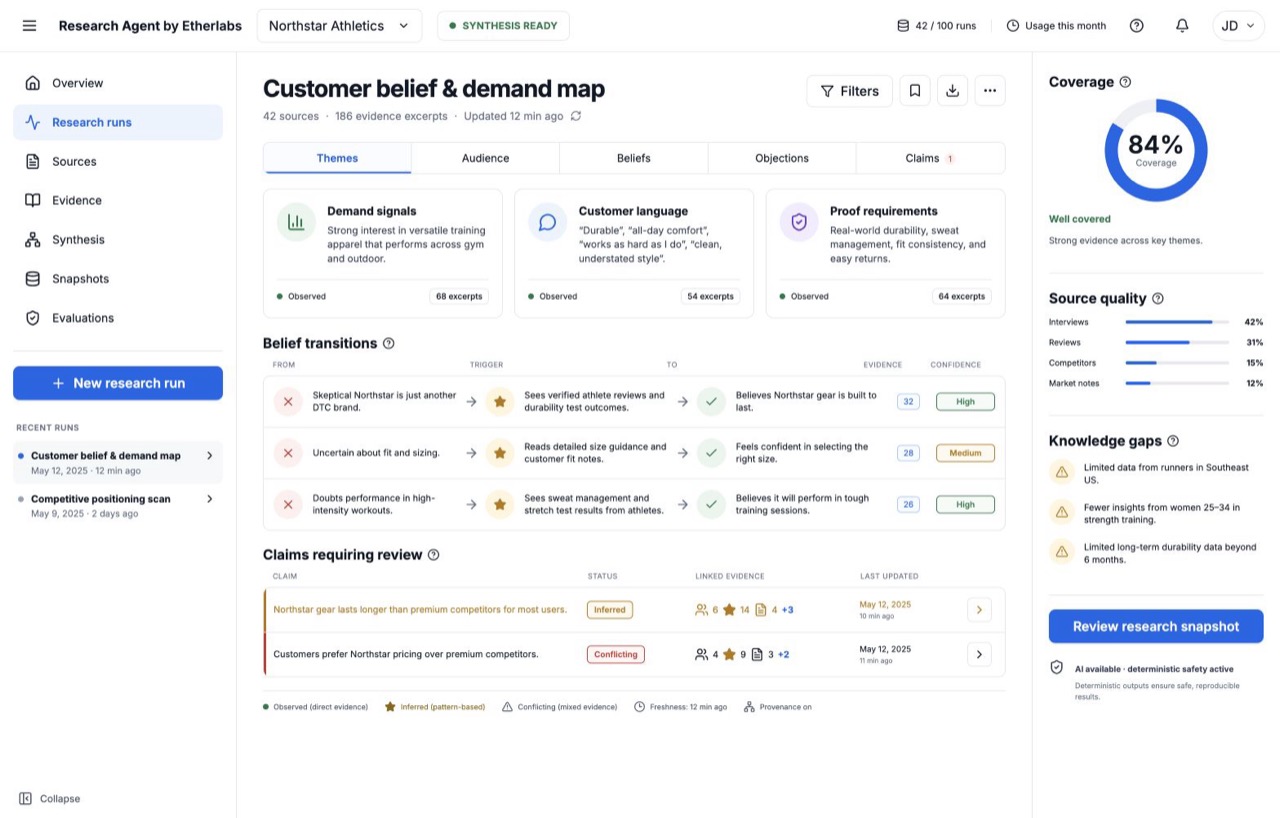
Source text is ingested reproducibly with content hashing, duplicate detection and untrusted-instruction flags. Synthesis produces a claim and evidence graph where each claim is classified observed, inferred, conflicting or unknown. Diagnostics report coverage, freshness, source quality and knowledge gaps, and a human reviews before anything becomes a versioned snapshot.
Reproducible ingestion
Content hashing and duplicate detection, so the same input produces the same corpus.
Untrusted-instruction flags
Source material that tries to issue instructions is flagged at ingestion, not obeyed downstream.
Claim classification
Observed, inferred, conflicting or unknown — the four states a research finding can honestly occupy.
Synthesis views
Belief transitions, demand signals, customer language and proof requirements.
Gap diagnostics
Coverage, freshness and source quality reported as first-class output.
Reviewable snapshots
A human approves; the snapshot is versioned. Nothing publishes or runs advertising.
03 — Architecture
How a research run executes
04 — Engineering decisions
Choices that keep research honest.
Four confidence classes, not a score
Observed, inferred, conflicting and unknown are categorical because they demand different actions. A 0.72 confidence number tells a reader nothing about whether to go and look.
Conflicting is a first-class outcome
When sources disagree the system says so rather than picking a winner. Contradiction in the market is a finding, and averaging it away destroys the most useful signal in the corpus.
Unknown is reported, not hidden
Knowledge gaps are surfaced as output. A research tool that always produces a full answer is a research tool that is sometimes lying.
Ingested text is data, never instruction
Untrusted-instruction detection runs at ingestion. Scraped source material is exactly where a prompt-injection payload arrives.
Deterministic without a provider
The workspace runs entirely on deterministic fixtures with no model key, so review behaviour can be verified independently of provider availability.
Nothing acts on the outside world
The system produces snapshots for review. It performs no live advertising or publishing action.
05 — Reliability & controls
What the system does when things go wrong.
06 — Evidence
Verified results
None published. No client research outcomes are claimed on this page.
Benchmarked results
Public dataset: 40-case deterministic evaluation suite, GitHub CI passing
Delivery tier: Runnable repository
Verification: lint · web tests · build · ruff · pytest · evals
Boundaries tested: cross-tenant hiding · unauthenticated denial · role boundaries
The suite asserts review behaviour and access boundaries rather than answer quality. Desktop and mobile browser verification was performed against the approved design concept, including safe-run, claim-review and snapshot-review interactions.
Simulated results
Northstar Athletics and Harbor Home, with their sources, metrics, findings and results, are entirely synthetic. Two synthetic tenant identities exercise manager, researcher and reviewer roles.
Projected business value
Not claimed. The migration and pgTAP suite are deployment-ready architecture artefacts, accurately labelled unexecuted.
Verified, benchmarked, simulated and projected figures are kept separate on purpose. A benchmarked number is never presented as a verified client result.
07 — Technology
Technology supports the story. The architecture and the controls are the story.
08 — Repository & demo
Research you cannot trace back to a source?
We can put evidence links, confidence classes and a coverage report between your inputs and the strategy built on them.