Applied AI / Media Orchestration
Multimodal Video Pipeline
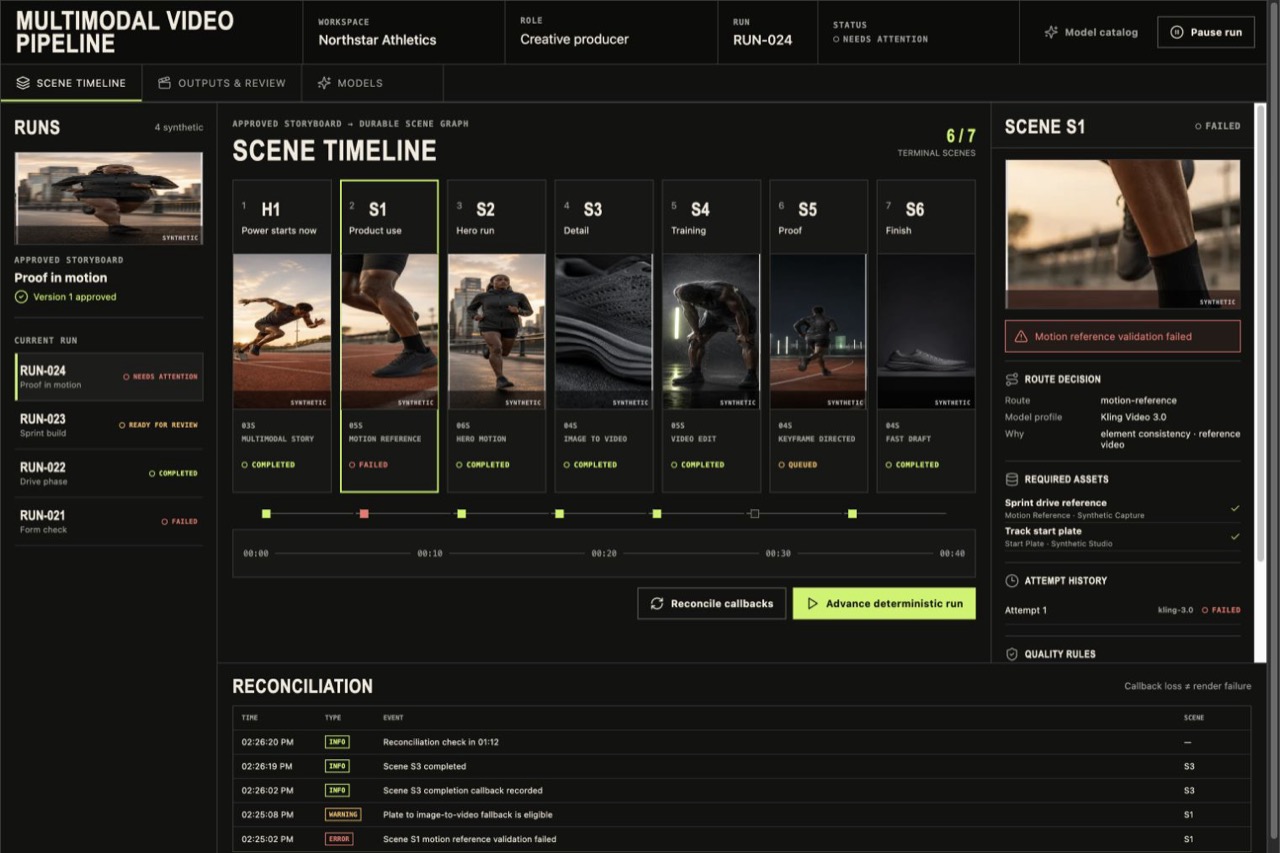
A production control room for routing, recovering, assembling and reviewing multimodal video work — where an approved storyboard becomes a durable ordered scene graph and every provider call is an asynchronous attempt that can be reconciled.
An independently branded Etherlabs reference implementation. The product is not Peerless production and contains no private Peerless material.
01 — The problem
Video generation is a distributed systems problem wearing a creative costume.
A single approved storyboard fans out into dozens of provider calls across different models, each asynchronous, each minutes long, each able to fail in a different way. Treat that as a series of API requests and you get a pipeline that loses work, double-charges, and cannot tell you which scene is actually finished.
Model choice compounds it. The right model for a 30-second joint audio-video story is not the right model for localized source-video editing, and the landscape changes monthly. Hard-coding a provider makes the system obsolete; routing blindly makes it unpredictable.
02 — The system
The storyboard becomes state, not a series of requests.
An approved storyboard is compiled into a durable ordered scene graph with explicit asset roles — image, video, audio, plate, motion reference and source video. Routing decisions are made against a dated model registry that records sources, modalities and duration boundaries. Every provider call is an asynchronous attempt with an HMAC callback, replay protection and reconciliation for callbacks that never arrive.
Durable scene graph
Ordered scenes with explicit roles, so the assembled cut is derivable state rather than a folder of files.
Evidence-backed routing
A dated registry records official sources, release dates, modalities, routing strengths and duration boundaries.
Asynchronous attempts
Every generation is an attempt with its own lifecycle, not a blocking call.
HMAC callbacks & replay protection
Signed callbacks with replay defence, plus reconciliation for lost callbacks.
One bounded fallback
A single route-aware fallback rather than blind retries against a minutes-long, billable operation.
Exact review & packaging
Hook manifests, caption-safe video, checksums, reviewer locks and local-only packaging.
03 — Architecture
How a storyboard becomes a reviewed cut
04 — Engineering decisions
The choices that decide whether it survives contact with production.
One bounded fallback, never blind retries
A video generation is minutes long and billable. Retrying blindly multiplies cost and latency without improving the odds, so a single route-aware fallback replaces the usual retry loop.
Lost callbacks are expected, not exceptional
Asynchronous providers drop callbacks. Reconciliation against provider state is a first-class path, because a system that only works when the callback arrives is a system that regularly strands work.
Idempotent, terminal finalization
Finalization is idempotent and states are terminal. This is what stops a duplicate callback from re-running an expensive assembly.
The registry records sources and dates
Each profile carries its official source URL and verification date. Where a vendor confirms a model without stating a launch date, the registry records the verification date rather than inventing a release date.
Deterministic adapters, honestly labelled
Adapters simulate the provider contract with committed synthetic media. The README states plainly that this does not mean a provider request was made — reachable profiles are not proof of live traffic.
Packaging stays local
Output is packaged locally with checksums and reviewer locks. No publishing integration exists.
05 — Reliability & controls
What the system does when things go wrong.
06 — Evidence
Verified results
None published. The product is not production software and no client outcome is claimed.
Benchmarked results
Public dataset: Model registry dated 12 August 2026, with committed verification checks
Registry: official source URLs · release dates · modalities · duration boundaries
Checks: API/security tests · UI tests · evaluations · TypeScript build
Also covered: Python and web lint · ownership · secret scanning
The registry is verification of what each profile is and where the claim comes from — not a performance comparison between models. "Deterministic adapter" means the repository simulates the provider contract with committed synthetic media; it does not mean a provider request was made.
Simulated results
Northstar Athletics, Harbor Home, their assets, events, failures, timings and outputs are synthetic evidence. Generated media is included for evaluating the repository and represents no real organisation or campaign.
Projected business value
Not claimed. No performance, revenue, ROAS, conversion, client-volume or provider-usage claim is made.
Evidence links
Verified, benchmarked, simulated and projected figures are kept separate on purpose. A benchmarked number is never presented as a verified client result.
07 — Technology
Technology supports the story. The architecture and the controls are the story.
08 — Repository & demo
Orchestrating expensive, slow, unreliable model calls?
We can make the work durable, the retries bounded and the cost predictable — before the provider bill teaches you the same lesson.